

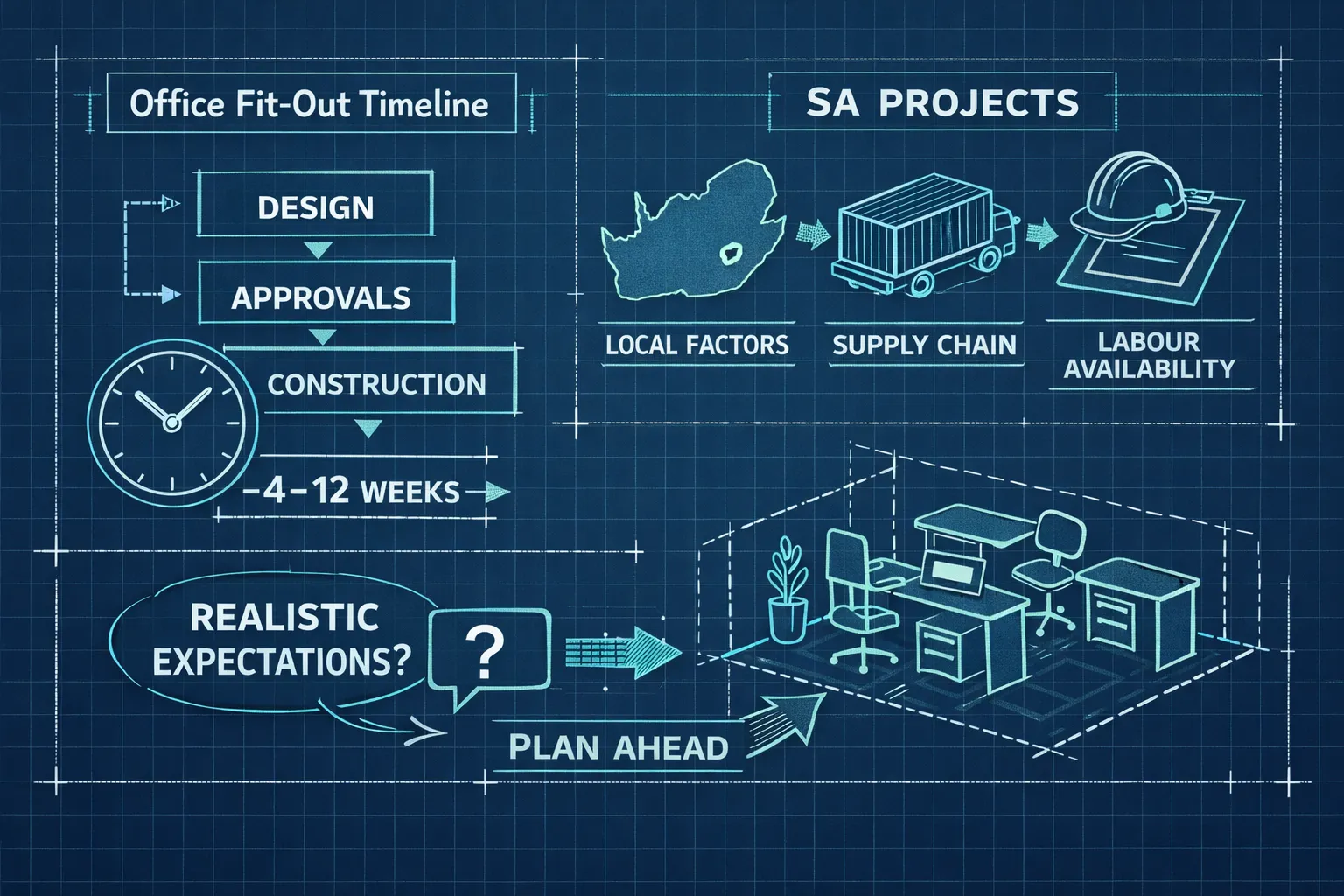
Office fit-out lead times: a realistic guide for SA projects
The moment it happens, you know it. You’ve signed the lease, you’ve told the team “we move in ten weeks,” and then someone who actually knows what they’re doing sits across the table and explains what ten weeks can’t fit. Design documentation. Landlord approval. Custom joinery on a twelve-week lead. Council submission. That’s when programme shock sets in, and the timeline you committed to is already fiction before a single partition goes up.
Office fit-out lead times are what most project owners underestimate, and it’s rarely through carelessness. Upfront numbers are hard to come by. The quotes and reassurances you do get tend to assume perfect conditions: instant approvals, off-the-shelf products, and a site that’s fully ready the day you want to start. None of those assumptions survive contact with a real South African project.
This guide gives you the honest numbers for office fit-out lead times. It shows what a realistic schedule looks like from design brief through to handover, stage by stage, for small through to large projects. It covers the long-lead items that quietly blow programmes apart, the approvals phase that most clients treat as a background task, and the tactics that actually compress timelines when applied at the right moment.
If you are reading this, you are likely staring down a new lease or a looming deadline, trying to figure out what is actually achievable. Thank you for taking the time to be here. We are Vortex Design Solutions. As a commercial fit-out team operating on the ground, we manage these complex programmes daily. We are sharing this information because we see exactly where timelines collapse before they even start, and our goal is to give you the clarity you need to protect your budget, your project, and your team’s sanity.
What actually drives office fit-out lead times
Lead times aren’t arbitrary numbers pulled from a schedule template. They’re the cumulative result of interdependent phases, each one dependent on the previous completing cleanly. While international guides offer a helpful baseline, relying on broad global assumptions often means missing critical local nuances. We have seen projects run into the millions in losses because of simple scheduling mistakes that could have been prevented with the right context. South Africa adds its own variables on top of what any international guide will tell you: a supply chain with real import constraints, local manufacturing capacity that runs on allocation for specialist trades, and a regulatory environment that requires proper planning rather than assumption.
Scale and fit-out complexity
Gross floor area and scope of works carry the single biggest influence on overall programme duration. A 200 sqm office receiving new joinery, partitioning and a fresh M&E connection is a fundamentally different project from a 1,500 sqm floor plate requiring full Cat B fit-out, demountable glazing systems, VRV HVAC upgrades and a bespoke reception installation. Both are “office fit-outs.” Their timelines share almost nothing in common. Understanding which category your project sits in is the first honest conversation any good fit-out team will have with you.
South Africa’s supply chain reality
When you download a standard office fit-out template online, it is almost certainly built for European or other markets. In our experience, we regularly see these downloaded schedules being used to plan local projects without the proper context. Those international timelines assume that when you need specialised acoustic panelling or architectural glazing, it is sitting in a warehouse down the road, ready for next-day delivery. Applying those assumptions to a South African supply chain is how budgets bleed.
Here, specifying imported finishing systems means building shipping schedules, port congestion, and customs clearance directly into your critical path. The logical alternative is to rely on our local manufacturers for custom joinery and bespoke commercial furniture. But South Africa’s best fabricators do not have infinite factory capacity; they run on strict allocations. You aren’t just buying a reception desk or a boardroom table; you are trying to secure a highly contested slot in a production queue.
This reality changes the fundamental sequence of a project. It means that in South Africa, procurement decisions cannot wait until the construction phase. If you are only placing orders when the builders arrive on site, your programme is already dead. The exact materials must be specified, approved, and ordered during the design stage. This is the operational pivot that dictates whether you move in on time, or whether you end up paying double rent for a month—an expensive lesson most clients only learn the hard way.
Design-and-build versus traditional procurement
The delivery model you choose at the start affects every week that follows. Traditional sequential procurement, design, then tender, then build, can add several weeks of elapsed time through handoffs and re-mobilisation, typically in the range of four to eight weeks depending on project size and complexity. A design-and-build model with a single accountable team can compress those phases considerably by running design and procurement in parallel. The saving isn’t theoretical. It’s the difference between design sign-off triggering a tender process and design sign-off triggering a procurement order that’s already been scoped.
Office fit-out lead times by project size: stage by stage
The ranges below reflect conservative planning estimates based on South African conditions in 2026, accounting for local approval timelines, current supplier lead times and normal site conditions. They are structured as realistic planning ranges rather than best-case outcomes, the kind of numbers that hold up on actual projects rather than ideal ones.
Small projects: under 500 sqm
Design and technical documentation takes two to four weeks for a straightforward small office. Procurement and landlord approval run concurrently and add two to four weeks, assuming drawings are submitted promptly and no structural modifications are involved. Construction and M&E typically run four to eight weeks on site, with snagging and handover adding one week. Total planning range: ten to eighteen weeks. The “eight-week fit-outs” you hear about are possible, but only where the design is simple, nothing bespoke is specified, and approvals are pre-cleared before the programme starts. Those conditions are the exception, not the rule.
Medium projects: 500 sqm to 1,500 sqm
Design and documentation extends to four to six weeks as technical complexity increases, with more detailed M&E coordination, multiple room types and more specification decisions to lock. Procurement for long-lead items needs to overlap with design sign-off rather than follow it; the buffer here is real and adds two to three weeks of parallel activity. Construction runs eight to fourteen weeks on site. Approvals and compliance close-out add two to six weeks depending on the scope of statutory submissions required. Total planning range: sixteen to twenty-eight weeks. The projects that hit the short end of this range are the ones where procurement started while design was still being finalised, not after.
Large projects: 1,500 sqm and above
At this scale, phased delivery is almost always necessary to keep the programme credible. Design and documentation runs six to ten weeks. Procurement of long-lead items needs to start eight to fourteen weeks ahead of installation, which means orders go in while design is still progressing.
Construction, including phased floor delivery, runs fourteen to twenty-four weeks. Compliance and handover documentation add two to four weeks per phase. Total planning range: twenty-four to forty-plus weeks. Projects in this tier are frequently delayed not by slow construction but by late procurement decisions and approval bottlenecks that were never properly programmed in the first place.
The long-lead items that trip up most fit-out programmes
Most project owners watch the construction phase for programme risk. In practice, it’s the items that need to be ordered weeks before a tradesperson arrives on site that cause the real damage. By the time the delay is visible, it’s already too late to recover without cost or scope changes.
Custom joinery and bespoke furniture
Full custom joinery (reception counters, boardroom fit-outs, built-in cabinetry) runs eight to fourteen weeks from confirmed shop drawings to site delivery in current market conditions. Bespoke furniture with non-standard materials or finishes can push to fourteen to twenty weeks. Semi-custom and catalogue furniture with local stock availability compresses this to three to six weeks. The decision between bespoke and semi-custom should happen at design development, not at tender stage; by tender stage, the programme has already been written around a lead time that may not be achievable.
HVAC, glazing and specialist ceiling systems
Demountable glazing systems sourced from offshore suppliers can carry lead times of ten to sixteen weeks once shop drawings are approved, though exact timelines vary by supplier and stock position. HVAC equipment for larger floor plates, particularly VRV and VRF systems, typically runs eight to fourteen weeks depending on local distributor stock levels. Specialist acoustic ceiling systems generally add six to ten weeks from order confirmation. These figures are illustrative; confirm current lead times directly with your suppliers and distributors at design stage. What matters programmatically is that all of these items need to be identified and ordered while design is still being finalised. Waiting until after tender to place these orders means the site will be ready before the products are, and that gap costs money every week it sits.
AV, IT infrastructure and access control
AV integration for boardrooms and collaborative spaces typically runs four to eight weeks for supply and one to two weeks for installation, though these figures should be verified with your AV integrator given current local market conditions. Structured cabling and IT infrastructure have shorter lead times but need early coordination with the main contractor to avoid ceiling and wall close-out being held up waiting for first-fix IT to complete. Access control and smart building systems generally add four to six weeks from specification confirmation. None of these are dramatic lead times in isolation, but they compound badly when they’re not in the programme from the start.
Approvals and compliance: the phase nobody budgets time for
In South Africa, statutory approvals are a genuine timeline variable. Treating them as a formality that runs in the background is one of the most reliable ways to lose unplanned weeks on a project, and in some metros, the approval cycle alone can run well beyond what most clients anticipate.
Landlord consent and design approval
Most commercial leases require landlord sign-off on design drawings, materials and M&E modifications before work starts. Straightforward projects with no structural modifications typically clear this in two to four weeks. Where structural modifications, external facade changes or complex M&E upgrades are involved, four to eight weeks is more realistic. Late submission of drawings to the landlord is one of the most common and most preventable causes of programme delay. Submit early, follow up actively, and build the response window into the programme as a fixed duration, not a background assumption.
Building plan submission and council approval
Where proposed works trigger formal building plan submission under the National Building Regulations, council approval in South Africa’s major metros typically takes four to twelve weeks for a compliant, complete submission, and resubmission cycles following queries or objections can add further time on top of that. Incomplete submissions, missing professional sign-offs or drawings that don’t meet SANS standards reset the clock entirely. Projects that require heritage authority input or special consent add further weeks. The overall process from pre-submission preparation through final approval can run ten to twenty-two weeks or more in complex cases. This phase must be designed into the programme as a scheduled activity with a real duration, not treated as something that happens in parallel without management attention.
Statutory inspections and occupation certificate close-out
The final phase adds two to four weeks to any project requiring formal close-out. This covers statutory inspections, compliance certificates for electrical, plumbing and fire, and the occupation certificate process. Skipping or delaying this phase creates occupancy risk and future liability for the client. The certificates required for a commercial office fit-out close-out in South Africa include the Fire Compliance Certificate covering SANS 10400 Part T requirements. These aren’t administrative afterthoughts; they’re what makes the space legally occupiable.
Proven tactics to cut weeks off your fit-out programme
Once you understand where the time actually goes, the question becomes how to recover it without cutting corners that come back as defects or compliance failures.
Start procurement before construction starts. Ordering long-lead items during design development, before tender and before full design sign-off, is the single most effective tactic available. On a medium project, starting procurement early can meaningfully compress the overall programme by ensuring joinery, glazing and HVAC land on site concurrent with site establishment rather than weeks after it. It requires confidence in the design direction and a procurement team that can manage the risk of early orders, but the programme saving is real and measurable.
Offsite fabrication is a second lever that works well when shop drawings are locked early. Joinery elements, modular partitioning systems and prefabricated ceiling components can be manufactured while strip-out and first-fix M&E work proceeds on site. When the site is ready, the factory-built elements install in days rather than weeks. This approach requires clear site access dates and a supplier with capacity reserved for your programme, both of which need to be confirmed early.
On larger projects, phasing the handover by zone or floor allows the client to begin partial occupation while remaining areas complete. This requires a programme structured around phased practical completion, with MEP and compliance close-out sequenced per zone. Done correctly, it can reduce effective delivery time on multi-floor projects, in well-managed cases by 20 to 30%, though outcomes vary by project structure and site conditions. It also gives the client visible progress at a stage when the programme can otherwise feel static.
Why lead time management starts on day one, not at tender
Everything in this article points to the same conclusion: the weeks you lose on a fit-out programme are almost never lost during construction. They’re lost in the gap between design sign-off and procurement, in the approval submissions that go in late, and in the bespoke specifications that lock in fourteen-week lead times after the programme has already been committed to a tighter schedule.
We, at Vortex Design Solutions, map office fit-out lead times into the programme from our very first design review. Our team identifies long-lead items during design development, confirms supplier lead times before we lock specifications, and stages orders to land on site exactly when the programme needs them. Throughout the construction phase, we run weekly cost, time, and risk reviews to flag supply risks before they cause delays, and we immediately adjust our sequencing the moment site conditions shift. This is active programme control, not schedule administration.
We also treat handover as a core deliverable with its own strict lead times. Instead of scrambling to gather paperwork in the final week, our team programs compliance certificates, as-built drawings, handover packs, and close-out documentation as critical scheduled activities. As a result, you receive a space you can occupy, insure, and operate immediately—not a site that is physically complete but legally unfinished.
Plan the timeline before you commit to it
Office fit-out lead times in South Africa are predictable when you plan for the right phases, identify long-lead items at design stage, and treat approvals as programme items with real durations. The realistic planning ranges are ten to eighteen weeks for small projects, sixteen to twenty-eight weeks for medium, and twenty-four to forty-plus weeks at scale. Those numbers aren’t pessimistic; they’re what well-run projects actually take when procurement, approvals and construction are managed as a connected programme.
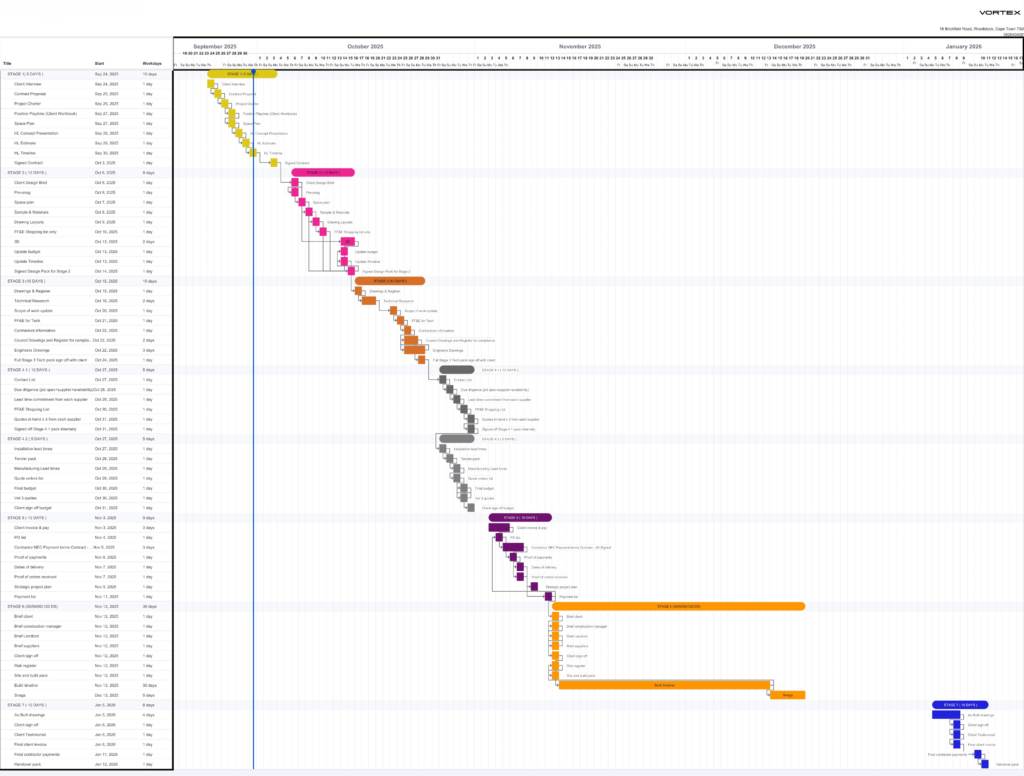
A real-world programme for a medium-scale commercial project. This 20-week schedule maps exactly how design, long-lead procurement, and construction phases must overlap to ensure a successful handover in South Africa.
Programme shock is almost always the result of skipping procurement and approval planning in the early weeks of a project, not a failure of the construction team. The fix is a delivery structure that builds lead time control in from the start, where design, procurement, compliance and construction are managed together rather than handed off sequentially between separate parties.
If you are planning an office fit-out or signing a lease in Cape Town and staring down a 60- to 90-day move-in window, the clock is already ticking. We built this guide for businesses expanding into new offices, call centres, or co-working spaces who cannot afford vague timelines or compliance delays. At Vortex Design Solutions, we build the critical milestones—City Council submissions, Fire COCs, electrical compliance, and HVAC sign-offs—directly into your programme from our very first conversation. If you want a team that treats strict legal compliance and hard deadlines as the foundation of your fit-out, reach out to us.
Let’s map a realistic schedule that actually gets your doors open on time.
No Comments
Sorry, the comment form is closed at this time.